
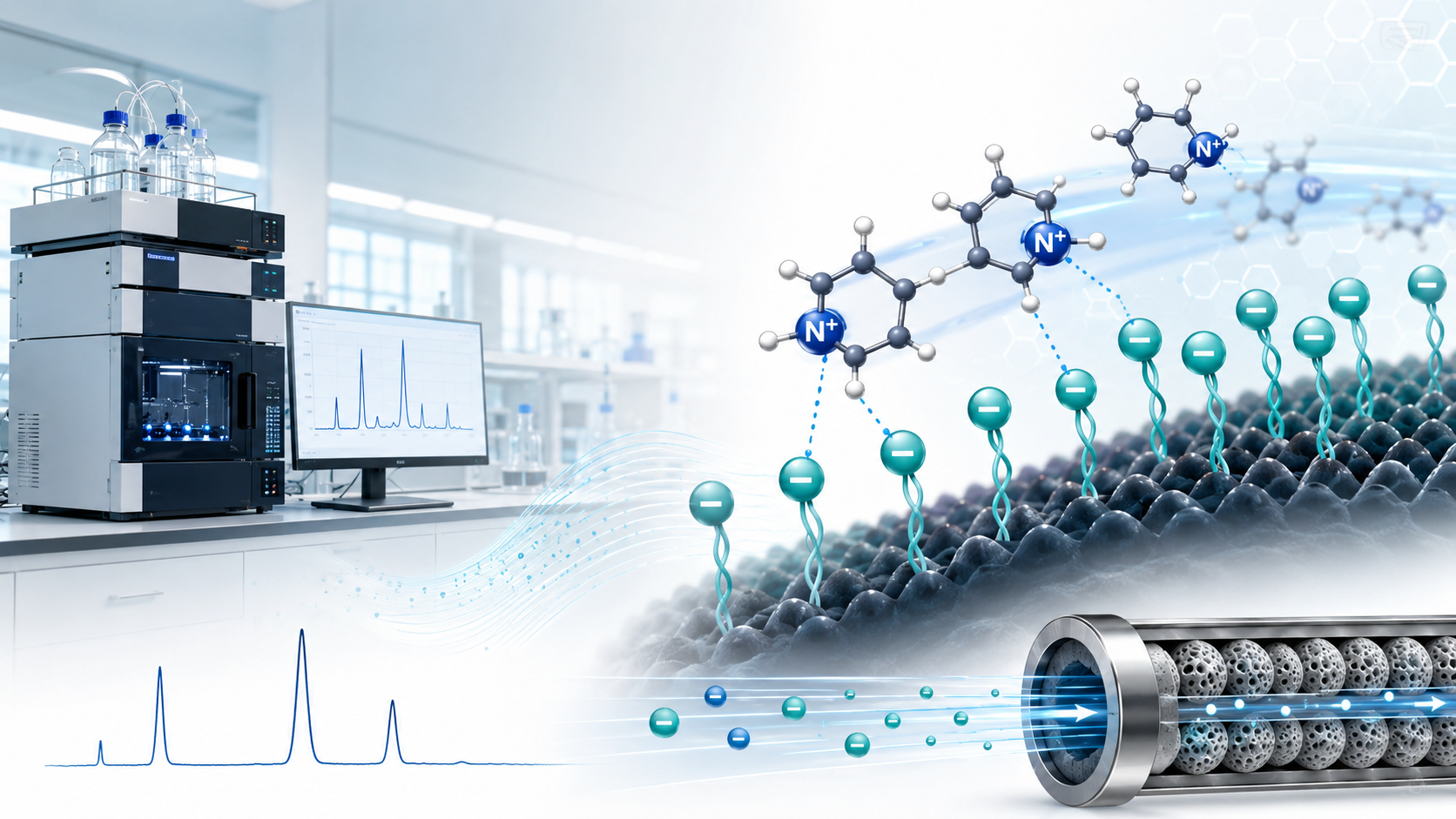
Why Some Molecules Need More Than Standard Reversed-Phase HPLC
Reversed-phase HPLC is one of the most widely used tools in analytical chemistry because it is versatile, reproducible, and well suited to many organic compounds. In a typical C18 method, analytes are separated based largely on their interaction with a hydrophobic stationary phase and a water/organic mobile phase. For neutral or moderately hydrophobic molecules, this approach often works well.
But not every analyte behaves like a neutral organic molecule.
Highly polar, permanently charged, or strongly ionized compounds may show little retention on a conventional C18 column. Instead of interacting meaningfully with the stationary phase, they can elute near the column void volume, show poor peak shape, or produce unreliable quantitation. This is a familiar challenge for ionic agrochemicals, quaternary ammonium compounds, organic acids, amines, and certain pharmaceutical or industrial actives.
Ion-pairing HPLC was developed to solve exactly this kind of problem. It allows an analyst to use a reversed-phase column, such as C18, while adding a carefully selected counterion to the mobile phase to change how a charged analyte interacts with the chromatographic system. Classic ion-pair theory describes retention enhancement for ionized analytes on nonpolar bonded phases when a hydrophobic counterion is present in the mobile phase. See, for example, Horváth, Melander, and Molnár’s foundational treatment of ion-pair chromatography: Retention of Ionized Compounds on Hydrocarbonaceous Bonded Phases by Ion-Pair Formation.
At Synergy Science Solutions, this type of method is especially useful when a client needs defensible chromatographic data for a compound that is too polar, too ionic, or too matrix-sensitive for a simple reversed-phase assay.
What Is Ion-Pairing HPLC?
Ion-pairing HPLC is a form of liquid chromatography in which an oppositely charged reagent is added to the mobile phase to improve the retention and separation of ionic analytes.
For a positively charged analyte, the mobile phase may include an anionic ion-pair reagent such as an alkyl sulfonate. For a negatively charged analyte, the mobile phase may include a cationic ion-pair reagent such as a tetraalkylammonium salt. The reagent is chosen so that one part interacts with the charged analyte and another part interacts with the hydrophobic reversed-phase environment.
This is why ion-pair reagents are often amphiphilic. They contain both an ionic head group and a hydrophobic tail. That dual character lets them act as a bridge between the aqueous mobile phase and the nonpolar stationary phase.
A simple teaching model is:
charged analyte + oppositely charged reagent → less polar ion-associated species → improved reversed-phase retention
That model is useful, but it is only part of the story. In real HPLC systems, the ion-pair reagent may also adsorb onto the C18 stationary phase, creating a dynamic charged surface that behaves partly like an ion-exchange phase. In practical method development, ion-pairing HPLC is best understood as a mixed-mode system: reversed-phase partitioning, electrostatic attraction, ion exchange, and solvation effects all contribute to the observed retention.
The Physical Organic Chemistry Behind the Method
Ion-pairing HPLC works because it changes the free-energy balance that controls whether an analyte prefers the mobile phase or the stationary phase.
A highly charged analyte is strongly solvated by water. Moving it from bulk aqueous solution toward a hydrophobic C18 surface is energetically unfavorable. The molecule carries charge, has a structured hydration shell, and often has little natural affinity for the hydrocarbon-like stationary phase.
The ion-pair reagent changes that balance in several ways.
First, it reduces the effective polarity of the analyte environment by associating with the charged analyte or by creating an oppositely charged layer at the stationary-phase surface.
Second, it introduces electrostatic attraction. A cationic analyte can interact with an anionic reagent; an anionic analyte can interact with a cationic reagent.
Third, the hydrophobic portion of the reagent can associate with the C18 phase, anchoring the ionic interaction close to the stationary phase.
The result is not simply “neutralization.” It is a controlled interfacial process involving hydrophobic interaction, electrostatic attraction, ion exchange, desolvation, and mobile-phase composition all at once. Horváth, Melander, and Molnár’s foundational work recognized both possible mechanisms: formation of a retained ion-pair complex and conversion of the stationary phase into a dynamically coated ion exchanger.
That is why ion-pairing methods can be powerful, but also why they require careful control.
The C18 Surface Is Not Passive
One of the most important concepts in ion-pairing HPLC is that the C18 column is not simply a passive hydrophobic bed. When an ion-pair reagent is added to the mobile phase, the surface chemistry of the column can change.
Consider an alkyl sulfonate reagent used for a cationic analyte. The hydrophobic alkyl chain can associate with the C18 bonded phase. The sulfonate head group remains oriented toward the mobile phase. This creates a surface that is no longer purely hydrophobic; it now has an anionic character at the interface.
A positively charged analyte can then interact with this dynamically modified surface. In that sense, the method becomes a hybrid of reversed-phase chromatography and ion-exchange chromatography.
This has several practical consequences:
- The column may need longer equilibration before retention times stabilize.
- The ion-pair reagent concentration can strongly affect retention.
- Organic modifier percentage can change both ordinary reversed-phase retention and the degree of reagent adsorption.
- Column history matters because ion-pair reagents can persist on the stationary phase.
For routine work, many laboratories dedicate specific columns to ion-pairing methods. That practice is not just conservative laboratory culture; it reflects the fact that the stationary phase has been chemically conditioned by the mobile phase.
Why Ion-Pair Reagent Selection Matters
The ion-pair reagent is one of the most important choices in the method.
For cationic analytes, alkyl sulfonates are common. The sulfonate group provides the negative charge, while the alkyl chain provides hydrophobic character. For anionic analytes, cationic ion-pair reagents such as tetraalkylammonium salts may be used.
The alkyl chain length matters. A shorter chain may adsorb less strongly to the C18 phase and provide weaker retention. A longer chain may increase retention but also increase equilibration time, column memory, and method sensitivity. In many applications, a mid-chain reagent such as hexane-, heptane-, or octanesulfonate provides a practical balance.
Ion-pair reagent concentration also matters. At low to moderate levels, increasing reagent concentration often increases retention of the oppositely charged analyte. But the relationship is not unlimited. At higher concentrations, surface saturation, changes in selectivity, increased background, or aggregation behavior can complicate the separation. Practical method development therefore requires deliberate optimization rather than casual adjustment.
A useful way to think about the selection is this:
- Charge controls attraction. The reagent must carry the opposite charge from the analyte.
- Hydrophobicity controls surface association. The reagent must interact strongly enough with the reversed-phase surface.
- Concentration controls surface coverage and retention. Too little may not retain the analyte; too much may reduce robustness.
- Compatibility controls usability. The reagent must be compatible with the detector, column, mobile phase, and downstream method requirements.
Mobile Phase Composition: More Than Elution Strength
In standard reversed-phase HPLC, increasing the percentage of acetonitrile or methanol usually decreases retention by making the mobile phase stronger. In ion-pairing HPLC, the organic modifier still affects elution strength, but it also affects the ion-pairing system itself.
Organic solvent can change how strongly the ion-pair reagent adsorbs to the C18 surface. It can alter the hydration of the analyte and counterion. It can influence ion association, surface coverage, peak shape, and selectivity.
This means a small change in acetonitrile or methanol can sometimes have a larger-than-expected effect. The analyst is not only changing solvent strength; they are changing the interfacial chemistry of the separation.
The best ion-pairing methods therefore treat mobile-phase composition as a critical variable. Organic content, buffer strength, pH, counterion concentration, and equilibration time all work together.
Why pH Still Matters
For weak acids and weak bases, pH controls how much of the analyte is ionized. That alone can determine whether ion-pairing is needed and how strongly the analyte is retained.
But even for permanently charged compounds, pH still matters.
The pH can influence residual silanol activity on silica-based columns. It can affect secondary interactions that cause peak tailing. It can determine the charge state of buffer components or competing ions. It can also affect analyte stability and the reproducibility of the overall system.
This is especially important for cationic analytes, which may interact with residual acidic silanol sites on silica. A well-designed ion-pairing method does not only create retention; it also suppresses uncontrolled secondary interactions so that the analyte produces a symmetrical, quantifiable peak.
In client-facing terms, this is where experienced method execution matters. Two methods may appear similar on paper, but small differences in pH control, mobile-phase preparation, or column conditioning can determine whether the chromatogram is reliable.
Diquat as a Practical Example
Diquat is a useful example because it represents the kind of compound that often challenges conventional reversed-phase HPLC. It is strongly cationic, highly polar, and not naturally inclined to behave like a neutral hydrophobic analyte.
A C18 ion-pairing method can make diquat chromatographically manageable by introducing an anionic reagent, such as an alkyl sulfonate, into the mobile phase. The reagent helps create retention through electrostatic interaction and hydrophobic surface association. The C18 column remains important, but the mobile phase chemistry becomes the key to selectivity.
The broader lesson is not limited to diquat. The same principle can apply to many difficult ionic compounds: herbicides, formulation actives, process impurities, degradation products, and charged industrial chemicals.
When a molecule is too polar for ordinary reversed-phase HPLC but not ideally suited to another platform, ion-pairing HPLC can provide a practical and powerful path forward.
What Makes Ion-Pairing HPLC Technically Demanding?
Ion-pairing HPLC is sometimes viewed as a simple additive strategy: add the reagent, retain the analyte, run the sample. In practice, the technique requires more care.
A robust method must control:
- Column equilibration. The stationary phase must reach a reproducible ion-pair reagent coverage before retention times are meaningful.
- Mobile-phase preparation. Ion-pair reagent concentration, buffer composition, pH, organic percentage, and mixing order can all affect performance.
- System history. Previous mobile phases and column usage can influence how quickly the method stabilizes.
- Peak shape. Tailing, fronting, or broadening may indicate secondary interactions, insufficient equilibration, inappropriate pH, or matrix effects.
- Matrix compatibility. Formulation components, salts, surfactants, and excipients can compete with the analyte or ion-pair reagent.
- Reporting basis. For formulated products, the reported result must be clear about whether the concentration is expressed as the active ion, salt form, or another specification basis.
These details matter because clients rarely need “a chromatogram” in isolation. They need data that can support a batch decision, formulation comparison, investigation, regulatory submission, or certificate of analysis.
Where Synergy Science Solutions Adds Value
Synergy Science Solutions supports HPLC analysis for regulated chemical products, including agrochemicals, pharmaceuticals, industrial chemicals, and dietary supplements. The company’s HPLC capabilities include active ingredient quantification, impurity or degradation profiling, stability-related testing, release testing, and method-fit support: HPLC Analysis at Synergy Science Solutions.
For ion-pairing HPLC, that method-fit mindset is essential. The right approach depends on the analyte, matrix, target concentration, documentation needs, and decision the client is trying to make. A straightforward active assay may require one level of method confirmation. A complex formulation, trace-level target, or regulatory-facing package may require more extensive specificity, precision, accuracy, robustness, or matrix evaluation.
Synergy’s quality program also emphasizes documented calibration, system suitability, method validation practices, second-person review, and traceable records, depending on the project scope: Quality & Compliance at Synergy Science Solutions. That quality framework is especially important for ion-pairing methods because reproducibility depends on disciplined control of the chromatographic system.
A Practical Way to Think About Ion-Pairing HPLC
The most useful way to understand ion-pairing HPLC is not as a workaround, but as a deliberate use of chemical equilibria.
The analyst is tuning the interface between the mobile phase and stationary phase. The ion-pair reagent changes the surface environment. The analyte responds to a combination of electrostatic attraction, hydrophobic interaction, ion exchange, and solvation effects. The chromatographic result is a controlled balance of these forces.
That is what makes the technique so valuable for difficult ionic analytes.
For compounds such as diquat and related charged actives, ion-pairing HPLC can transform weak retention and poor peak shape into a usable, reproducible separation. When properly developed and executed, it gives clients more than a peak on a chromatogram. It provides decision-ready analytical data grounded in sound separation science.
Need Ion-Pairing HPLC Support?
If your active ingredient, impurity, or formulation component is too polar or too ionic for a standard reversed-phase method, Synergy Science Solutions can help evaluate whether ion-pairing HPLC is the right analytical path.
Share your analyte, matrix, expected concentration range, method reference if available, and reporting objective. Our scientists can help determine whether a C18 ion-pairing method, an alternate HPLC mode, LC-MS, or another analytical strategy is the best fit for your project.